Empyrean
The Empyrean is the tenth and highest heaven of Dante's Paradiso, the ultimate realm of pure light, love, and the direct presence of God, where the blessed souls reside in eternal beatitude and the poet receives his final vision of the divine. It is not a physical sphere like the nine planetary heavens that precede it, but a timeless, spaceless region of pure intellectual light, the true home of all the saved and the endpoint of the pilgrim's entire journey. Here, the structure of the cosmos gives way to a direct, unmediated experience of the Creator, and the narrative of the poem reaches its culmination in the vision of the Trinity and the Incarnation.
Nature and Location
The Empyrean is described as "the heaven that is pure light; / Light intellectual replete with love, / Love of true good replete with ecstasy, / Ecstasy that transcendeth every sweetness" . It is the "heaven which most his light receives" , the source from which all other heavens derive their power and motion. Unlike the lower spheres, which are physical bodies in space, the Empyrean is a "light above, which visible / Makes the Creator unto every creature, / Who only in beholding Him has peace" (E14061-E14063). It expands itself in a circular form "to such extent, that its circumference / Would be too large a girdle for the sun" (E14064-E14066). The Empyrean is the "top of Primal Motion" , the point from which all creation receives its vitality and power. It is the realm where God "immediately doth govern" , and where the natural laws of space and distance are irrelevant: "There near and far nor add nor take away" .
The White Rose of Paradise
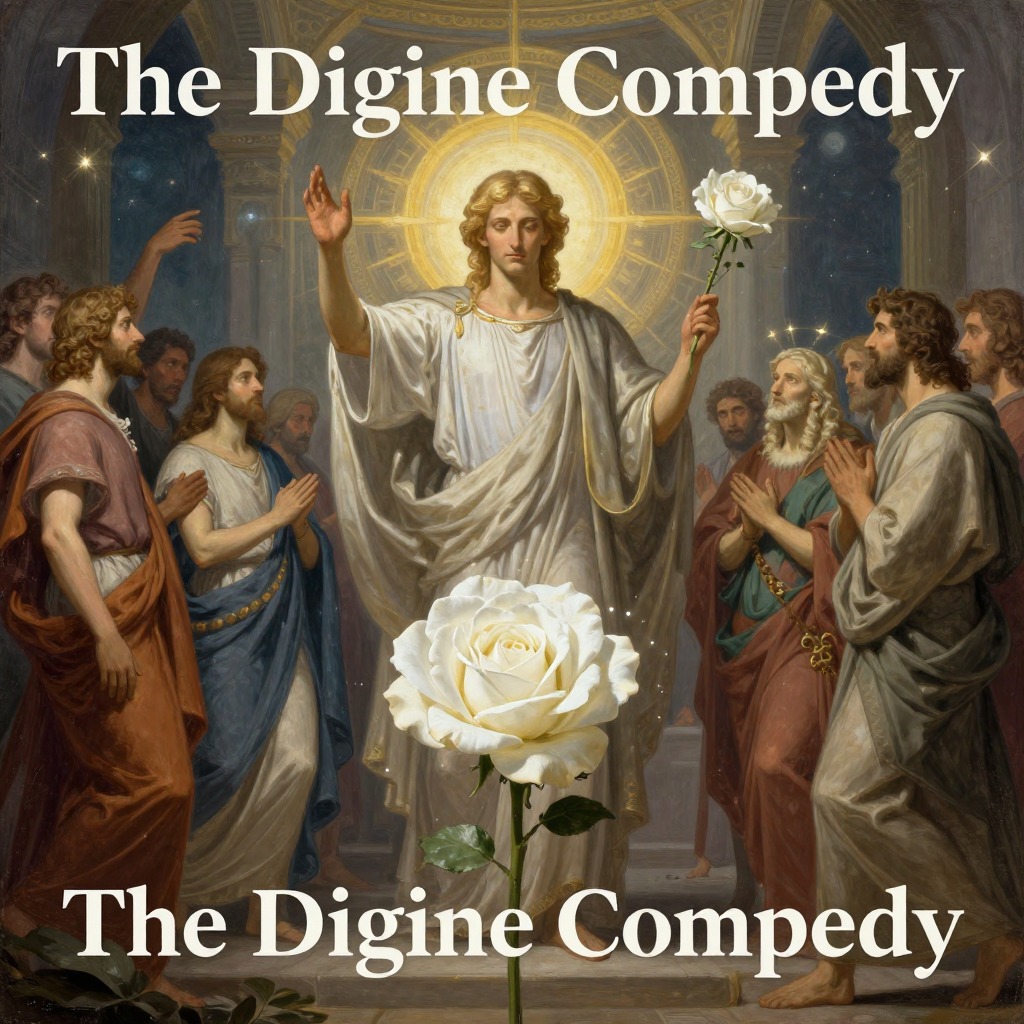
Within the Empyrean, the blessed souls are arranged in the form of a vast, snow-white rose . This "Rose Eternal" spreads, multiplies, and breathes an odour of praise unto the ever-vernal Sun (E14085-E14087). The poet sees "more ranks than a thousand" of souls mirrored in the light, all who have returned from the mortal world (E14073-E14075). The rose is so immense that even its lowest row collects a great light, and the poet's vision comprehends "all / The quantity and quality of that gladness" (E14079-E14081). The souls are seated on petals, arranged in a hierarchy of beatitude, yet all are content in their allotted place, for "in his will is our peace" . The Virgin Mary sits at the center of the rose, crowned by the Archangel Gabriel, and the greatest saints—Peter, John, Adam, Francis, Benedict, Augustine—are arranged around her (E14257-E14289).
The Two Courts of Heaven
The Empyrean contains two distinct hosts: the triumphant Church, composed of the blessed souls of humanity who form the white rose, and the angelic host, which flies between the rose and God, singing and carrying peace and ardour (E14114-E14128). The angels have faces of living flame, wings of gold, and bodies of such whiteness that no snow can compare (E14123-E14125). They descend from bench to bench into the flower, and then reascend to where their love abides (E14120-E14122). The light divine penetrates the universe so that nothing can obstruct the sight or splendour (E14132-E14134). The entire realm is "secure and full of gladsomeness, / Crowded with ancient people and with modern, / Unto one mark had all its look and love" (E14135-E14137).
The Vision of God
The climax of the Paradiso occurs in the Empyrean, where Dante, guided by St. Bernard's prayer to the Virgin Mary, is granted a vision of the Godhead. He sees the Eternal Light, which is "sole in thyself that dwellest, / Sole knowest thyself, and, known unto thyself / And knowing, lovest and smilest on thyself" (E14529-E14531). Within the light, he perceives three circles of threefold colour and one dimension, representing the Trinity (E14521-E14525). The second circle, reflected from the first like a rainbow, seems painted with the human effigy, revealing the mystery of the Incarnation (E14536-E14537). The poet's desire and will are finally turned, "even as a wheel that equally is moved, / The Love which moves the sun and the other stars" (E14549-E14550). This final line of the poem encapsulates the Empyrean's ultimate significance: it is the realm where the individual will is perfectly aligned with the divine will, and where the entire cosmos is seen as an expression of love.
Narrative Significance
The Empyrean is not merely a location but the theological and narrative destination of the entire Divine Comedy. It is the place where the pilgrim's journey from the "dark forest" of error reaches its fulfillment. The Empyrean is first mentioned in the Inferno as the city and lofty throne of the Emperor who reigns above (E00335-E00336), and it is the goal that Virgil, who cannot enter, promises Dante will reach through a worthier soul (E00329-E00331). The Empyrean is also the home of Beatrice, who descends from it to summon Virgil to Dante's aid (E00415-E00417). In the Paradiso, the ascent through the nine planetary heavens is a preparation for the Empyrean, where the souls appear not in their assigned spheres but in their true, eternal order. The Empyrean is the realm of the "Beatific Vision," the direct contemplation of God that constitutes the ultimate happiness of the blessed. It is the place where all the threads of the poem—theological, political, personal—are gathered into a single, unified vision of divine love and justice.